This is fairly basic but a common query none-the-less:
Q. How do you calculate conversion uplift?
A. Winning% - Old% / Old% x 100 = UPLIFT%
Simple!
You can hire my services
I am Ben Lang an independent web conversion specialist with over 20 years of experience in IT and Digital and 12 years Conversion Rate Optimization (CRO) know-how.
I provide a full analysis of your website conversion performance and the execution of tried and tested CRO optimization exercises through AB testing, split testing or MVT (Multivariate testing ) deployed to fix your online conversion issues.
Contact me at https://www.benlang.co.uk/ for a day rate or catch up with me on LinkedIn
Blog Post Labels
ab testing
(73)
multivariate testing
(68)
conversion rate optimization
(67)
quick wins
(64)
Google experiments
(10)
Maxymiser
(7)
VWO
(4)
check-out
(4)
Seasonality
(3)
Visual Website Optimizer
(3)
campaign
(3)
culling
(3)
mvt
(3)
split testing
(3)
A/B testing
(2)
CRO
(2)
Google
(2)
Google Analytics
(2)
Google Trends
(2)
Gutenberg
(2)
HiPPO
(2)
MVT testing
(2)
Magazines
(2)
SEO
(2)
Statistical Significance
(2)
Twitter
(2)
amazon
(2)
basket
(2)
calculating uplift
(2)
compare
(2)
mobile
(2)
page fold
(2)
wilkinsonplus.com
(2)
$1
(1)
99p
(1)
Aviva
(1)
BlinkBox
(1)
Digital Content Summit 2015
(1)
Diminishing Returns
(1)
Eye tracking
(1)
Increasing average basket value
(1)
Keywords
(1)
Map Overlay
(1)
Native app
(1)
Netflix
(1)
Omniture
(1)
Optimizely
(1)
Page rating
(1)
Personization
(1)
Testimonials
(1)
VCB
(1)
Viking
(1)
Website redesign
(1)
analysis
(1)
browser size tool
(1)
checkout
(1)
conversion rate optimisation
(1)
cross-selling
(1)
data alchemy
(1)
discount code
(1)
facebook
(1)
fatwire
(1)
google browser size tool
(1)
heatmaps
(1)
iOS
(1)
iTunes
(1)
insights
(1)
landing page
(1)
marketing
(1)
net.finance 2011
(1)
neuromarketing
(1)
non-financial KPIs
(1)
paywall
(1)
popular posts
(1)
presentation
(1)
promo code
(1)
reptilian brain
(1)
retail
(1)
segments
(1)
session capture
(1)
session recording
(1)
short wave testing
(1)
whereisthefold.com
(1)
£1
(1)
Above the fold - The Google Browser Size Tool
Here's one I'd stumbled across a couple of years back now and had subsequently forgotten about but Lord knows why because it's so useful and so simple in it's conception. Google Labs has a Browser Size tool that let's you overlay a summary of browser size (based on visits to the Google homepage) over any web page. For a while people had spoken about there being no page fold when it came to web design. Well that's poppycock, if multivariate testing and UX testing has taught us anything it's that if you have content which people have to scroll down to a lot of people will either not bother or just not realize the content is there in the first place. In testing I've found that if you cant get away from a lengthy page you need to make the design imply that its worth scrolling to the content or try and bring everything back above the fold through tabbed design etc.
The conception of Short Wave Testing
Right, well this is really work in progress. I think I've invented a new form of multivariate testing on the web. And for clarity this has nothing at all to do with Short Wave Radio. However, a couple of points to start off with; A) I'm not entirely sure it hasn't been done before and B) It's a valid test methodology.
Well hang it this blog is all about being a testing 'Maverick' so here goes nothing....
First off, let's not get confused by Iterative Wave Testing as used by Optimost. I think I'm right in saying that's where you test the same variants over a sustained period in 'waves' of testing to ensure what you have is validated and statistically significant. All very worthy, good stuff.
What I've been experimenting with is trying a set of test variants in one brief wave of testing and then ditching or culling any negative or lesser performing variants in favor of an entirely new variant in a new wave of testing that sees the positive or successful variants carried forward from the last wave. The whole process is repeated for as many waves as it takes to get a robust set of variants that out-perform everything else pitted against them. The only qualifying criteria for a variant to be carried forward to the next wave of testing is that they either continue to outperform the original default design or better the performance of anything that has gone before them, i.e; anything that has been previously removed.
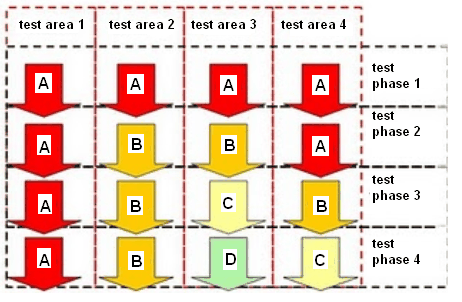
I hope this simple (ish) diagram illustrates how this short wave testing works. Below we have 4 test areas in a web page and we have 4 phases of testing. As we can see in Test Area 1, Variant A is successful enough never to be culled from the test and ultimately becomes the winner for Test Area 1. Test Area 2 shows an initially unsuccessful Variant A that is culled after the first phase of testing and replaced with a new variant B which goes on to be the winning variant of Test Area 2. Test Area 3 has a different story, in the end it takes 4 different variants over 4 phases of testing to find a variant that is positive enough to be declared a winner. And Test Area 4 arrives at a winner on the third phase of testing with variant C.
Now I'm aware that this form of testing is both labour intensive and resource-heavy in it's undertaking. I was able to do this kind of testing because I was both motivated enough to dedicate resource to it and had enough ideas in the locker that I wanted to test for each test area and test wave. I used Google Optimizer to do it and coded the variants myself and the outcome has been, well staggering. A sustained uplift in the region of 18% for product purchase has been achieved (a personal best BTW) and to me I am reasonably confident in the results because the final variants I had, had reported consistently the same uplift over 9 separate waves of testing.
What I'm hoping for now is the counter-argument from my testing peers (drop me a line at farmerfudge@googlemail.com). I'm aware of the shortcomings of this approach but want others to have their say on this kind of testing methodology. Here's my bonfire, feel free to piddle all over it : ) Happy Testing!
UPDATE: One thing worth noting with this testing approach is that if it goes right your conversion rate for the test variants should improve for each wave where you attain, keep or build on positive performing variants but at the same time you will also see a diminishing uplift for each wave. This is because you are continually testing against improved and stronger performing variants in the test segment. Ultimately though you should still see a good uplift against the underlying original default design.
Well hang it this blog is all about being a testing 'Maverick' so here goes nothing....
First off, let's not get confused by Iterative Wave Testing as used by Optimost. I think I'm right in saying that's where you test the same variants over a sustained period in 'waves' of testing to ensure what you have is validated and statistically significant. All very worthy, good stuff.
What I've been experimenting with is trying a set of test variants in one brief wave of testing and then ditching or culling any negative or lesser performing variants in favor of an entirely new variant in a new wave of testing that sees the positive or successful variants carried forward from the last wave. The whole process is repeated for as many waves as it takes to get a robust set of variants that out-perform everything else pitted against them. The only qualifying criteria for a variant to be carried forward to the next wave of testing is that they either continue to outperform the original default design or better the performance of anything that has gone before them, i.e; anything that has been previously removed.
I hope this simple (ish) diagram illustrates how this short wave testing works. Below we have 4 test areas in a web page and we have 4 phases of testing. As we can see in Test Area 1, Variant A is successful enough never to be culled from the test and ultimately becomes the winner for Test Area 1. Test Area 2 shows an initially unsuccessful Variant A that is culled after the first phase of testing and replaced with a new variant B which goes on to be the winning variant of Test Area 2. Test Area 3 has a different story, in the end it takes 4 different variants over 4 phases of testing to find a variant that is positive enough to be declared a winner. And Test Area 4 arrives at a winner on the third phase of testing with variant C.
What I'm hoping for now is the counter-argument from my testing peers (drop me a line at farmerfudge@googlemail.com). I'm aware of the shortcomings of this approach but want others to have their say on this kind of testing methodology. Here's my bonfire, feel free to piddle all over it : ) Happy Testing!
UPDATE: One thing worth noting with this testing approach is that if it goes right your conversion rate for the test variants should improve for each wave where you attain, keep or build on positive performing variants but at the same time you will also see a diminishing uplift for each wave. This is because you are continually testing against improved and stronger performing variants in the test segment. Ultimately though you should still see a good uplift against the underlying original default design.
No need to shout about it
I've been running an MVT test on a comparison page and recently introduced an 'Ends Soon' label next to the product call to action. Initially the presence of this message was negative. I resized the image by half making it much smaller and the conversion results are much improved, illustrating that sometimes people just don't want to be shouted at : )
Update: Although this 'hurry message' didn't work well with this particular page which was a product comparison page the same image used on an already optimized product page using Maxymiser has led to a 44% uplift in product application submit rate.
An Offline Call To Action
A recent MVT test using Google Website Optimizer answered the question.
"Exactly what impact does having an off-line Call To Action next to an on-line have?"
In this test I would measure the impact upon the click to apply rate on a landing page where using MVT I would serve up a link to a pop-up window which would show both a telephone sales number and a branch locator to a section of the page visitors.
During the test period, in addition to monitoring the test console results I monitored the Google Analytics report for the pop-up window.
Here's the summary of results:
675 Visitors saw the default (no offline CTA)
248 of which click Apply = 36.7% Conversion rate
678 Visitors saw the offline CTA variant
205 of which click Apply = 30.2% Conversion rate
The offline CTA variant is down –17.7% in Conversion rate
against the default page
The offline CTA pop-up received 569 Unique Views in the
test period. Therefore 83.9% of people who see an offline
CTA will click it.
Subscribe to:
Posts (Atom)