

The professional blog of Ben Lang a Conversion Rate Optimization practitioner since 2008. Here I share my test results, testing experience & occasionally some thoughts. You can hire my CRO services at benlang.co.uk
Google Analytics Intraday reporting
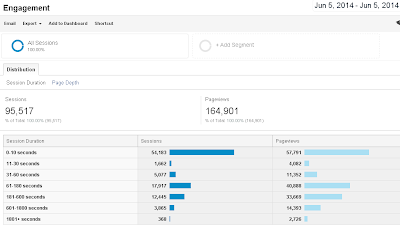
Here's a tip if you, like me need to get an intraday view of traffic volumes on your website. In the current version of GA go to Reporting |Audience | Engagement and select the current day from the calender. This report will give you your traffic volumes for the current day. If you need to see realtime volumes you can of course view the Realtime section of GA.


Throwing baby out with the bath water. Website redesign.

The Optimisation landscape has changed. Have you kept up?
 A number of things have changed in the world of MVT testing, AB testing and Conversion Rate Optimization (CRO) generally over the last few years. The question we have to ask of ourselves and the people we work with is whether we have truly kept pace with these changes. I've asked this question a lot recently and a number of areas have been found wanting.
1. The economic collapse of 2008 changed everything both in terms of the economy but also the web, how eCommerce businesses either thrived or died. The reduction of cash flow in internet businesses both drove the argument for testing and improving your online experience to squeeze the very last drop of our traffic and it also threw greater intensity on the need to prove ROI . If CRO was ever seen as peripheral then this was the time to prove your worth and justify the ongoing investment as a core player in the online channel not waiting in the wings. Verdict: Done OK. Could do better.
2. Web traffic has radically shifted into different segments. The Mobile and Tablet device accounts for around 30% of web traffic at the moment and continues to rise. As a consequence traditional fixed web testing is becoming less and less relevant as each day passes. If you're not actively testing in these new segments now it may already be too late. Despite some early and ongoing dabbling in these emerging segments we have failed to make any real inroads in terms of replicating the successes achieved in desktop testing. Verdict: Strong start but faded fast.
3. Are still looking at the same things to test time and again? Sometimes you need to retest the same concepts and experiences especially those user journeys core to your sales and service funnel but sometimes you need a fresh pair of eyes on your business to get new insight and ideas. Verdict: Good but room for improvement.
4. Your choice of testing vendor is still key. The things you look for in a testing partner are those that can help address the shortcomings mentioned above. Someone who does enable testing in those emerging segments, who continually helps evidence ROI for your CRO activity to the budget holders, and someone who is proactive and brings fresh ideas and insight to the table. More importantly now you need someone who wants to be embedded in your business and add value day in day out and doesn't get complacent. Verdict: TBC
I firmly believe that MVT and CRO can still offer huge uptick in web performance for the online player. I guess the biggest danger is falling into patterns of working and thinking that worked well in the past but don't necessarily work as well today. Continual self assessment and re-evaluation of all the components in your testing programme should still yield success but you might have to make some tough decisions and change to bring about renewed success.
Here's a few things I've discovered through a LOT of testing
These are some of the findings I've discovered through many years of testing in a bid to retain this valuable knowledge and avoid past mistakes, I'm sharing them with you now. You're welcome : )
Some key testing findings.....
1. Place Call-to-Action on bottom right. Always.
2. What are the 3 main features/benefits – ‘unique value proposition? Now are they immediately obvious on your page? No? Put them there.
3. Do you have credibility indicators for your website; testimonials, reviews, awards, stats? Use them. Ideally as secondary content. By that I mean placed in content that isn't a lead up to your main Call To Action but in content below or to the side of it.
4. If you can drive people to a product page instead of a hub/portfolio page, do it.
5. Avoid additional links on your page. Generally speaking these are just leakage points. Customers will use them given the opportunity.
6. Strongly differentiate between products where they are jointly visible on the same page.
7. Is your copy generating any fear? If you have to throw up a negative messages relating to your product such as "this *** if used incorrectly will kill you" consider the tone of voice in which you do it.
8. We’re not selling features, we’re selling solutions to customer problems. Need led propositions works. Always.
9. White space can be used to make a page look less ominous. Too much and it makes it look amateurish.Get an eye for balance.
10. Too much of one colour on a page leads to information blindness. Avoid the Sea of Red/black/yellow.
11. Anything that rotates or animates tends to draw focus to your static secondary content. Place your proposition in the static content.
12. Ensure continuity of look & feel in the journey. You’ll increase drop-out if you ask a customer to go through multiple brand look & feel experiences. Continuity and flow.
13. Your existing customers are considerably more likely to buy from you than new customers. Differentiate between the two segments whenever possible. Use a sense of loyalty.
14. Remove choices. Yes you should always support multichannel but be aware if you offer a CTA to offline channels you are generally loosening your online sales funnel.
15. Understand where the visitor came from. If you said something in a PPC Ad make sure it’s reiterated in your page front & centre. If they came from a Partner/Aggregator they are a ‘hotter’ lead and need reassurance that you’re up to the job of giving them a solution to their ‘need’.
16. People don't read on the Web. Study after study has shown that less content on a landing page leads to higher conversion rates. Ruthlessly edit your text down to simple headlines and short, bulleted lists. Cut out the self-promoting marketing speak that people won't read anyway. You can link to detailed information on supporting pages.
17. Despite what many people say there IS a page fold. Be aware of it and if it’s crucial to the user journey and the value proposition it SHOULD be above the page fold.
NEVER SECOND GUESS THE CUSTOMER. TEST MULTIPLE EXPERIENCES & THEORIES. LET THE PUBLIC DECIDE WHAT WORKS.
Happy testing : )
Letting go
The human capacity for subjective or indeed plain sentiment in web design is fascinating. As optimisation specialists we testers or CRO experts hold little stock by either of these two concepts and have sacrificed both these a longtime ago in favour of asking the general population what web experience works best. And yet you can conduct some quite clinical testing on the value of a specific web design or element and put hard facts & figures behind its actual value in the user journey but still be told THAT widget or page design is staying because the product team wanted & designed it. Classic case & point this week in my world of testing. We have a web page where the primary call to action is a savings calculator. Some indepth analysis showed that visitors who engaged with this widget converted at just 1%. Conversly visitors who didn't engage with the calculator converted at a staggering 12% by comparison. MVT testing backed this up conclusively. This calculator deserved no place in the sales funnel. Presented with the hard, black & white facts the stakeholder was intent on retaining this ill conceived widget because it was the baby of person X and cost £££££ to build. In conclusion, sometimes you can never win out with testing. Sometimes subjectivity & sentiment wins despite evidence to the contrary. Sometimes either the client or you need to learn to let go. Be strong. Happy testing : )
Subscribe to:
Posts (Atom)