

The professional blog of Ben Lang a Conversion Rate Optimization practitioner since 2008. Here I share my test results, testing experience & occasionally some thoughts. You can hire my CRO services at benlang.co.uk
First mobile landing page test
I launched a Google Otimizer Ab test at the start of the week to see if I could drive an uplift in Mobile Banking registrations. Essentially the newly launched landing page for mobile banking had a CTA for the registration form but it was available on only the last tab of a 4 tab page design. Using GWO I added the same CTA to the footer of the page so that it was available across all tabs. Within just a few days the new design was beating the old design hands down with a +200% uplift in people clicking through to the registration form with a 99% confidence index. I'll add an image of the design soon. Update: the design has sustained it's uplift 3 weeks on. We now have a 10.5% conversion versus 1.5% for the old design.


Popular posts
Thought I'd compile a list of the most popular posts on this blog based upon web stats to date:
1. Is FatWire any good?
2. Culling multivariate test variants
3. The Gutenburg Rule
4. Above the fold - The Google Browser size tool
5. How do you calculate uplift in a multivariate test?
6. Review of Google Website Optimizer
7. The Law of diminishing returns in testing.
8. Riding the tsunami - testing during a traffic spike.
9. Short wave MVT testing.
10. An offline call to action.
Maxymiser - Multiple KPIs
A natty little feature of the Maxymiser reporting interface is the ability to report on multiple KPIs within the same report. Below is a screen grab of a conversion report which reports on both the 'Application submit rate' referred to as KPI 1, whilst also showing the performance of the secondary KPI 2 of 'Click to Apply rate' for the same test combinations. In the past you would have to flick between separate reports for each KPI, whereas this is obviously no longer the case.

To enable this feature you simply select multiple KPI or Actions in the report filter drop-down menu within the Maxymiser console. See illustration below.

Charlotte 29th Oct 2011
Google Analytics - Map Overlay
Lessons learnt from Retail* #1
I know Google Analytics (GA) has had it's Map Overlay function for sometime now, a report in GA which shows geographically where your online traffic comes from. Recently though I've had a degree of exposure to the retail sector as opposed to just the financial sector. With this particular brand it was interesting to see how the online traffic so accurately matched up with the branch locations. See image below, on the left is GA map overlay report for the brand and on the right you see its store locations. An incredibly obvious relationship appears between online activity and store location illustrating in retail how branch locality drives online brand awareness.

This kind of thing just doesn't happen in the financial sector where online traffic bears no immediate correlation with the offline world and the companies branches.
Obviously though when there is a match there's a geotargeting opportunity if you chose to act upon that information. This is obviously taken to a higher level with augmented reality applications in the mobile world where there are great marketing opportunities when GPS technology meets the highstreet retail opportunity. I will cover this in more detail in a later post.
*I've been privileged to get access to the web analytics of a retail brand lately. In a brief series I will cover insights I've found between the retail world and the financial sector where I specialize as an online optimization expert
I know Google Analytics (GA) has had it's Map Overlay function for sometime now, a report in GA which shows geographically where your online traffic comes from. Recently though I've had a degree of exposure to the retail sector as opposed to just the financial sector. With this particular brand it was interesting to see how the online traffic so accurately matched up with the branch locations. See image below, on the left is GA map overlay report for the brand and on the right you see its store locations. An incredibly obvious relationship appears between online activity and store location illustrating in retail how branch locality drives online brand awareness.
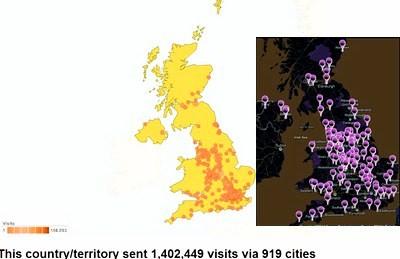
This kind of thing just doesn't happen in the financial sector where online traffic bears no immediate correlation with the offline world and the companies branches.
Obviously though when there is a match there's a geotargeting opportunity if you chose to act upon that information. This is obviously taken to a higher level with augmented reality applications in the mobile world where there are great marketing opportunities when GPS technology meets the highstreet retail opportunity. I will cover this in more detail in a later post.
*I've been privileged to get access to the web analytics of a retail brand lately. In a brief series I will cover insights I've found between the retail world and the financial sector where I specialize as an online optimization expert
Tracking uplift post ab testing

I know it sounds reckless, to continue to track uplift is the responsible thing to do right? But in reality there's an important aspect of optimisation testing that needs to be taken into consideration here. Testing outcome is usually the result of the following variables:
product benefit + moment in time + market position + customer experience
Can you continue to accurately measure and account for each of these factors after you've conducted a test? The honest answer is probably no. Also I don't know many people with the personal bandwidth to monitor every single test once it's finished. If I wanted to double my workload I certainly would!
The important thing to do is ensure is that your test has been given enough testing time and traffic volume in the first place before you conclude the test as this post reasonably states Don't Fool Yourself with A/B Testing. If you've done that you should have a reasonable level of confidence in it's future performance.
If you still want to track uplift after testing I would suggest the following are available options for you:
1. Set up a Google Analytics Goal. This gives you the ability to track the performance of a specific customer journey within your normal web analytic. Yes you have to use Google for this one, but any web metrics tool worth it's salt will have the same functionality.
2. Leave your test running. This to me is the fail-safe option. Once you have a test winner up-weight this in favour of the default content but leave a small percentage of your traffic going to the default as a benchmark for continued performance. I usually leave 5% going to the default for a period of time where possible to ensure I've made the right decision.
3. Run a Follow-up experiment. This is a great feature in Google Optimizer but you can do the same in any other testing tool if you have the resource to do it and there's lingering doubt about the original test outcome.
4. Bespoke tracking. On the pages I optimise I append tracking values to the application form that when submitted to a sales database can be used to tie back sales to a specific landing page. Using this approach you can monitor conversion rate performance before, during and after a test. I cant recommend this approach enough and is entirely dependent upon your on-line application forms particular design as to whether you can implement it.
That's about it really. If I think of any other methods for ongoing tracking I'll add them in.
Happy testing!
Subscribe to:
Posts (Atom)